The idea
Most pregnancy apps cover one stage and then hand you off to another app. Plenty of them track a lot, but few do anything useful with the data. We wanted one calm, honest app that stays with a family from trying to conceive, through pregnancy, to their baby's first year, and that turns what people log into guidance.
What we built
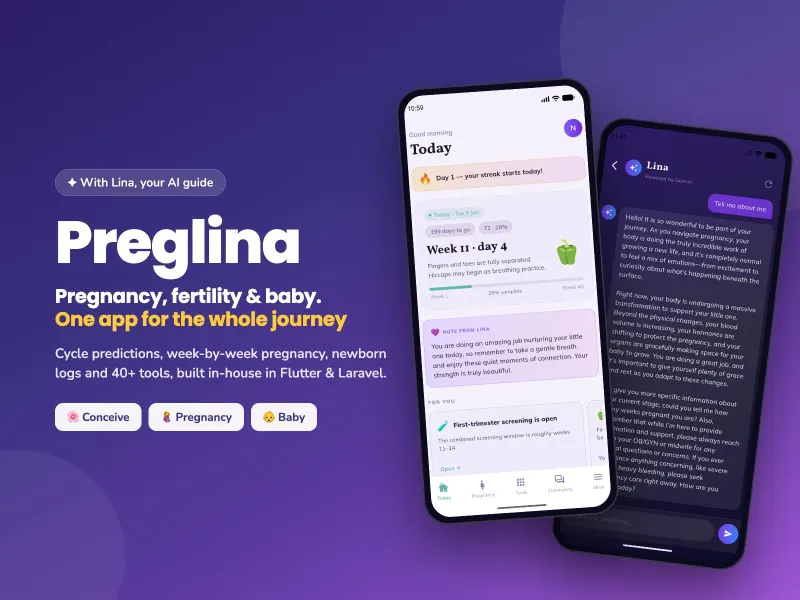
One app, three life stages. Users choose trying to conceive, pregnant or postpartum, and the home screen, tools and notifications change to match. Switching stages keeps all their history.
Predictions that learn. Most apps assume a 28-day cycle with ovulation on day 14. Preglina doesn't. Its cycle engine learns cycle and period length from the user's own logs, confirms ovulation with ovulation-test peaks and temperature shifts, and shows how confident each prediction is. The same engine runs on the server, so the app and the API always agree.
A Today screen that's actually about today. A rules-based insight engine ranks what matters this week: the dating scan, the 20-week scan, a reminder to count kicks, the fertile window, the baby's first vaccines. It rotates daily so the feed stays fresh. Streaks and a short daily note from Lina bring people back.
Lina, the AI companion. Lina knows the user's stage and week, keeps the conversation history, and can produce a weekly report on the user's logs as a PDF. All AI calls go through our backend, so no API keys ship inside the app.
Health Guard. A free safety layer that is never behind the paywall. Nine clear, rules-based checks watch for severe blood pressure, signs of preeclampsia, reduced baby movement compared with the user's own normal, high glucose, fever, bleeding and a high postnatal depression (EPDS) score. A warning is pinned to the top of the app with clear advice to contact a doctor or midwife.
"Is it safe?" A searchable reference of 251 foods, activities, beauty and household products, and medicines, with advice for each trimester. Our team edits it from the admin panel.
Doctor Visit Companion. Before an appointment, the app summarises what has changed since the last visit and suggests questions to ask, chosen for the user's stage. Users can add notes afterwards and export the whole thing as a PDF.
40+ tools. Temperature charting, ovulation tests, cervical mucus, kick counter, contraction timer, blood pressure and glucose, weight gain, fundal height, birth plan, hospital bag, feeding, sleep, diapers, pumping, WHO growth percentiles, milestones, vaccines, postnatal depression screening, guided exercise, plus a birth club community and a partner mode.
Under the hood
Flutter client for iOS and Android, with home-screen widgets and full English localisation
Laravel 13 REST API with Sanctum tokens, rate limiting, GDPR data export and deletion, caching and indexed queries
Offline first: logs save straight away and sync when the connection returns
Firebase for sign-in, analytics, performance monitoring and push notifications
Blade admin panel for articles, exercises, vaccines, the safety database, legal pages, feature flags and users
Preglina Plus subscription with in-app purchase receipt checks
A test suite on both sides: over 100 backend tests and about 100 Flutter tests covering the prediction, insight and safety engines
Built to be careful
Preglina is a health app, so it says so. There's a clear medical notice, AI answers are labelled as general information, and every warning sends the user to a real clinician. We removed all placeholder numbers from the UI, so everything users see comes from their own data.